A place where time stands still: Prehistory and/or Posthistory

Posted in Franchise as form, Writing with tags , , , , , , on 22 April 2025 by Ben

The following is a drafty of a chapter from my book project on Star Wars: Andor. The plan was to have the book done before season two premiered. Given that season two debuts today, that’s not going to happen and I expect that a good deal of what I have finished will need to be rewritten. So I am sharing the work I have done, a sort of time capsule of my thinking on the show and on franchise more broadly.

Chapter Two

A place where time stands still: Prehistory and/or Posthistory

We left Cassian Andor suspended between past and future, between past life and future life, between past death and future death. More precisely, we left Cassian suspended among and within the complex relationality of manifold pasts and manifold futures. Cassian does not walk away from a past or towards a future, nor does he walk away from a future and towards a past. He walks away from a past in which he had a sister, in which he searches for his sister, even if this past will only be recounted in a future towards which he is walking. He walks away from a past in which he has already died even as he walks towards a future in which he has not yet to died but will. He walks away from a past in which he has been forgotten even as the actions he is about to take will become the condition of that forgetting.

While these pasts and futures may be ordered in any number of ways, none of those ways will be superior, more natural, or more original (in the sense of “providing an origin or point of commencement”) than any other. Whatever claim we might make about the best or proper ordering of these pasts and futures must confront competing claims with no more or less authority than our own. We might, for example, after having completed Andor, and with full knowledge of the films that precede it historically, produce an ordering according to which Cassian has already died (in 2016) by the time the series premiers (in 2022). This ordering dissipates any narrative tension with regard to the question of Cassian’s survival, but it expresses a certain tonal intensity, a sense of doom that colors all of his actions in the series. By contrast, we might produce an ordering according to which Cassian’s fate remains unknown, the actions of the series (set in BBY 5) preceding the events of Rogue One (set in BBY 1). This ordering expresses the narrative tension just described but excludes the tonal intensity. Each of these orderings is rectilinear in one manner or another. The former involves an historical rectilinearity (grounded in the release order of franchise contents) that begins with Cassian’s murder of Tivik in Rogue One and moves through his death at the end of that film and thus onto the events of Andor. The latter involves a narrative rectilinearity (grounded in Star Wars’s internal chronology) that begins with young Kassa on Kenari and proceeding through his incarceration, his search for his sister, his flight from Ferrix, and so on unto his death on Scariff. Such rectilinear orderings would stand in contrast to orderings that mix narrative and history and thus produce circularities, spiralarities, and other topologies without names, especially insofar as these other orderings might involve other franchise contents, whether narrative and canonical or otherwise. What prevents us from starting our narrative with the scene in Rogue One when Cassian first appears onscreen with Mon Mothma before proceeding to a “flashback” that identifies the senator as the character who first appeared in Return of the Jedi discussing the many Bothans who died delivering news of the second Death Star to the Rebel Alliance and then onto a “flashforward” that recounts the individual journeys that Mon and Cassian take, in Andor,to the Rogue One scene, all intercut with scenes from films, series, and other media relating to the design, development, deployment, and destruction of the several Death Stars that populate the franchise? In short, nothing but the prospect of the non-trivial amount of labor it would require to produce and consume this ordering.

Continue reading
BBY 5: Andor, Andor, and/or “And/Or”

Posted in Franchise as form, Uncategorized, Writing with tags , , , , , on 22 April 2025 by Ben

The following is a drafty of a chapter from my book project on Star Wars: Andor. The plan was to have the book done before season two premiered. Given that season two debuts today, that’s not going to happen and I expect that a good deal of what I have finished will need to be rewritten. So I am sharing the work I have done, a sort of time capsule of my thinking on the show and on franchise more broadly.

Chapter 1

BBY 5: Andor, Andor, and/or “And/Or”

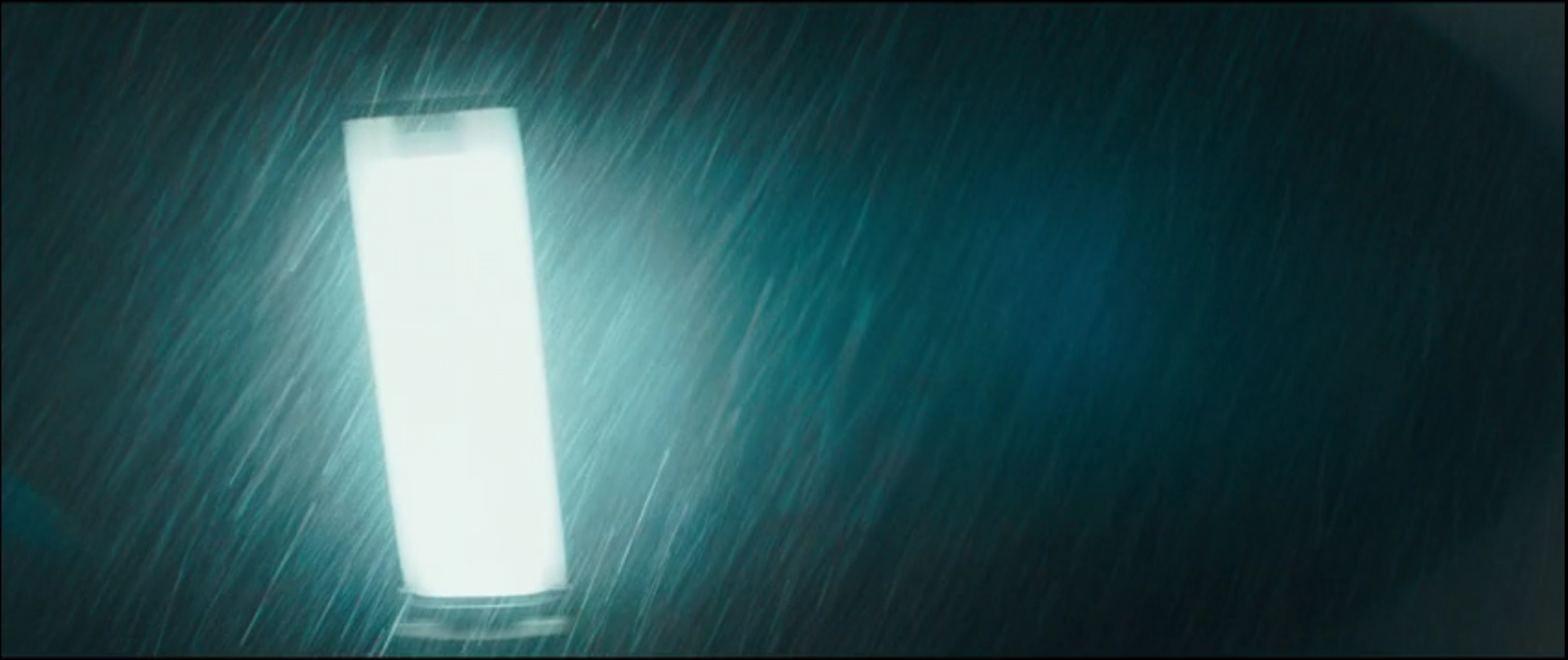
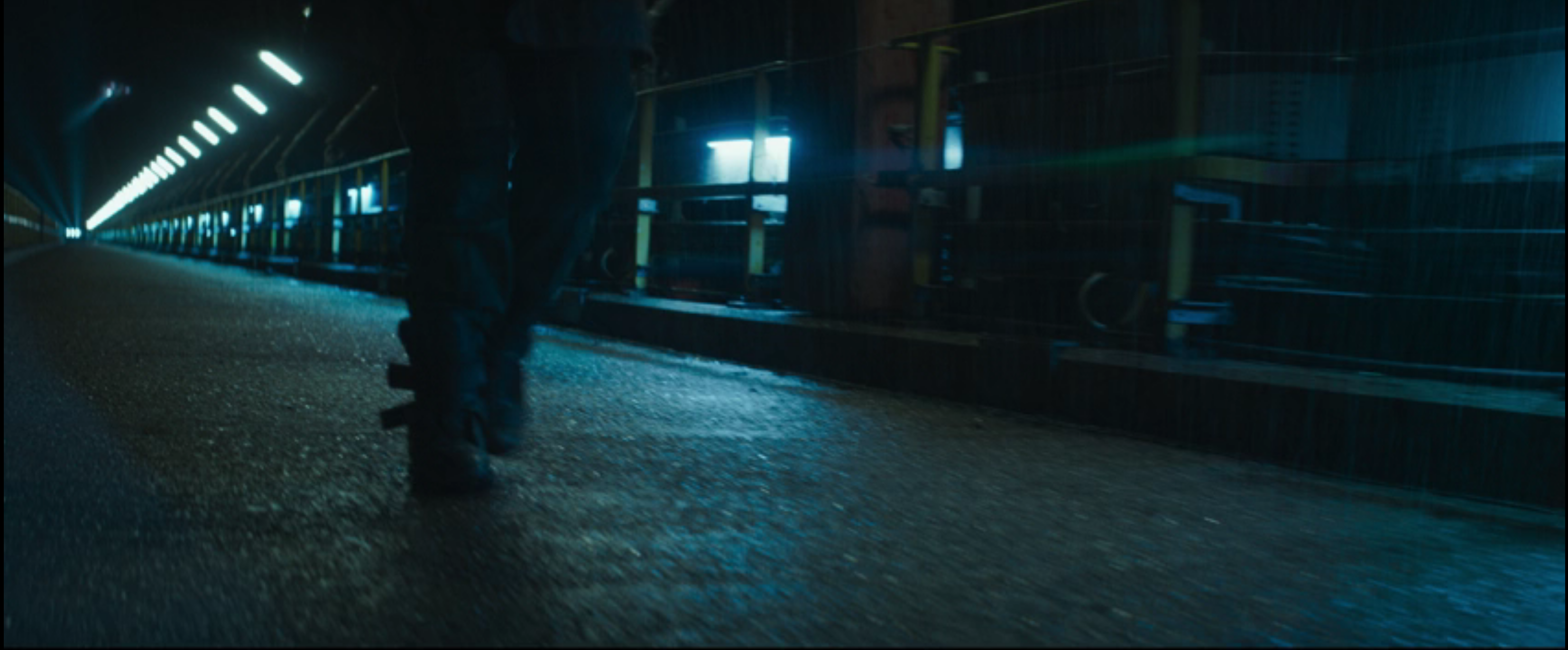
Andor begins with a low angle shot of lights set against a dark and stormy night (Figure 1). As the camera tracks from left to right, new lights appear and disappear. At first the appearances of these lights are punctuated by the score, but as the camera begins to pan to the right the lights and the music fall out of sync. As the camera continues to track and pan, a human figure becomes visible, walking parallel to the lights along a causeway towards a cityscape dimly outlined against the rain and the darkness. A cut to a second shot, at a lower angle, reorients the camera and the viewer. This shot focuses on the hooded figure’s legs set against a perspectival line opposite the one created in the first shot by the convergence of the lights, the causeway, and the camera’s movement. Rather than converging on a point in space ahead of this figure, this second, new perspectival line converges on a point behind him (Figure 2). Another cut presents a wider view of the causeway and the lights vanishing in the distance, of the figure who continues to move towards the vanishing point, and of the cityscape. This third shot offers neither forward nor backward movement but only a crane up that centers the vanishing point in the frame and positions the hooded figure just below it. As the camera settles in space and the shot concludes in time, a legend appears on the right side of the frame. The legend adds to the frame a second organizational scheme (the vanishing point being the first), one that divides it vertically into three unequal sections. The left hand section mainly contains the lights with which we began. The middle, and narrowest, section articulates the convergence of the lights, the street, the camera’s movement, and the hooded figure with the cityscape. The right hand section, again, contains three lines of text set against a darkness barely broken by the distant cityscape: “Morlana One/Preox-Morlana Corporate Zone/BBY 5” (Figure 3).

Figure 1: Andor Season 1, Episode 1 (00:01:07): Streetlight and street darkness.

Figure 2: Andor Season 1, Episode 1 (00:01:16): Legs, lights, and the past.

Figure 3: Andor Season 1, Episode 1 (00:01:34): The future and the past.

Continue reading

Franchise Fictions: Course Materials

Posted in Franchise as form, Teaching, Writing with tags , , , , , , , , , , , on 14 January 2022 by Ben

I proposed a new class for our department last year, the catalog title for which is “Popular Culture, Critical Reading.” That title is intended to be broad enough for other people to teach, important in that the course is offered at the 2000 (or 2nd-year) level and is aimed at non-English majors.

However, I always thought of it as a class that examines the nature of franchise as an object of interpretation and all of the baggage that franchises come with (the nostalgias of different audiences, the OBVIOUS relation franchise has to capitalism and production, the size of many franchises and the shifting nature of the megatexts they produce, and so on).

Continue reading

WandaVision not Television: Franchise on the Small Screen

Posted in Conferences, Franchise as form, papers, Writing with tags , , , , , , , , , , , , , , , on 24 June 2021 by Ben

What follows are my notes for my SFRA talk this past weekend.

WandaVision not Television: Franchise on the Small Screen

So I have been interested in franchise for a while and have been presenting on the subject at SFRA and elsewhere for the past few years. In these presentations and in a few roundtables I have mainly discussed filmic instances of franchise, such as Star Wars Episode VII: The Force Awakens and the Iron Man and Captain America trilogies. My shift here to a discussion of what used to be called television has to do with what seem to me new ways franchises are making use of the medium and our nostalgia for it. Examples of this shift to original serialized streaming content that develop franchise storyworlds at critical moments in the history of a franchise include WandaVision and the Mandalorian and, more recently, The Falcon and the Winter Soldier and Loki. My cautious and perhaps vague thesis regarding these “shows” states that they represent processes within Star Wars and the MCU distinct from older instances of franchise television such as Star Trek: The Original Series or The Next Generation, Star Wars: The Clone Wars, or even Marvel’s Agents of Shield.

Continue reading

Two conference proposals: on WandaVision and The Mandalorian (for SFRA 2021) and on Afropessimism, Afrofuturism, and History (for Imagining the Impossible)

Posted in Conferences, Franchise as form, papers, Writing with tags , , , , , , , , , on 10 February 2021 by Ben

Benjamin J. Robertson

Proposal for SFRA 2021

WandaVision not Television: Franchise on the Small Screen

Recent instances of franchise on the small screen, such as Marvel’s WandaVision and Star Wars’s The Madalorian, demonstrate the challenges scholars of genre and media face when analyzing franchise texts. Specifically, insofar as they participate in older/other media forms, here television but elsewhere film or video games, instances of franchise obscure their participation in franchise itself, a production model that we can trace back to at least the first James Bond films that has now evolved into something more like a narrative form. This obfuscation occurs not on the levels of production, marketing, or consumption. It occurs at the level of meaning and interpretation. As a quasi-narrative forms, franchise is difficult if not impossible to analyze and understand all at once as complete texts (and individual franchises present their own, unique difficulties to critics). At the same time, individual texts within the franchise remain difficult to understand outside of the franchise framework that conditions them whatever meaning they possess.

This paper takes WandaVision and The Madalorian as case studies of the franchise form’s new incursion into television programming in the context of streaming services such as Disney+. Previous instances of franchise on television (such as Marvel’s Daredevil or Star Wars’s The Clone Wars) follow the production models of conventional television programming. WandaVision and The Madalorian challenge such models in several ways. Most importantly, each demonstrates the potential of franchise to incorporate perhaps any aspect of cultural production into itself even as it undermines the conventional limits and affordances of various media. WandaVision remediates the American television sitcom as a container for social conflicts, one that evolves over the course of its lifespan starting with the rather banal narratives of the 1950s and moving through subsequent decades that saw the sitcom form deal with questions of race, gender, sexuality, death, and so on. At the same time, complexities and conflicts specific to the MCU cannot be contained by the sitcom at all and force WandaVision into the meta-discourse of franchise and thus destroy our capacity to understand it or interpret it as television. The Mandalorian remediates its own franchise by way of the toys that have always been at its commercial heart. Individual episodes of the show seem less concerned with advancing an overall franchise narrative (or even presenting new narrative ideas for each episode) than they do with providing backdrops against which action figures, speeder bikes, and sandcrawlers perform the set pieces at the heart of the sort of play nostalgic fans participated in as children. Taken together, and in relation to other new instances of franchise, these shows underscore our need for new interpretive frameworks, new theories of media, and a new concern for monopolies on cultural production. This last concern is no longer simply about one or two corporations that control the production, distribution, and exhibition of texts. It is now a concern that these corporations are coming to own the very forms these texts take.

Benjamin J. Robertson

Proposal for Imagining the Impossible

Afropessmism and Afrofuturism: Re-imagining Fantastika after History

The scholarly discourses on Afropessmism, by Frank Wilderson and Christina Sharpe, for example, and Afrofuturism, by Kodwo Eshun and Alondra Nelson, for example, implicitly and explicitly adopt concepts and structures that derive from the several subgenres of fantastika, especially fantasy, science fiction, and horror. However, insofar as these discourses reject progress (Afropessmism) or seek to rethink the narrative threads that connect past to present and future (Afrofuturism), they also demonstrate the limitations and problems inherent to these subgenres, including fantasy’s nostalgia for a past of plenitude, science fiction’s imagining of a truly novel future that will break with the past, progress, and horror’s dismissal of all narrative structure and meaning. These problems, I argue, derive from fantastika’s origins in the eighteenth and nineteenth century, as described by John Clute, Fredric Jameson, and Carl Freedman, among others. Insofar as fantastika emerges in response to the advent of historical consciousness in the wakes of the bourgeois revolutions in France and North America and of industrial capitalism, it reflects on three basic understandings of history—that history is but is bad (fantasy), that history is and is good (science fiction), and that history is not (horror)—while only rarely reflecting on the historicity of history itself, on the fact that our idea of history was and is historically determined. Now, after the end of the metanarratives of the Enlightenment (Lyotard) and of history itself (Fukuyama, Flusser), fantastika continues to reflect the concerns of those who write and read it even as it undergoes transformations that challenge some of its original tendencies. This paper investigates Afropessimism and Afrofuturism as discourses that adopt, adapt, and undermine the historically conditioned “truths” of fantastika by way of points of view, concepts, and narratives structurally excluded from fantastika by way of the historical moment of its birth and the historical consciousness of that moment.

Course materials for Black Feminist Speculative Fiction

Posted in Teaching with tags , , , , , on 12 January 2021 by Ben

People on Twitter asked for the course materials for my upcoming Multicultural Literature class on Black Feminist Speculative Fiction, so here it is.

I wish there was a more coherent narrative to the course, but I realized how little time I left myself for getting it ready and rather than try to make it perfect I just tried to work in all of the materials I wanted to get to.

We are not really reading much on genre, although this is course on genre in many respects. Rather than focusing on how genres have been defined, largely by white critics and scholars, we will be looking at how black women have revised genre and how black feminists have set the stage for discussion of these revisions and their place within generic, national, and world histories. I wanted to include only women writers, but did wind up including three secondary texts by black men, from Wilderson, Eshun, and Sarr, because of how they introduce three topics crucial for the class (Afropessimism, Afrofuturism, and African modernity).

That all said, I think it came out pretty well. Here are the docs:

Reading list and schedule for my graduate class on Weird and New Weird Fiction

Posted in Teaching, Uncategorized with tags , , , , , , , , , , , , , , , , , , , , , , , , , , , on 27 July 2020 by Ben

In case anyone is interested, here is the mostly finalized reading list and schedule for ENGL 5529-002, on Weird and New Weird Fiction, which starts up in a few weeks. Some small things might change, but this is the gist of it.

I chose not to do a chronological survey. Rather, I have organized the readings around methods, genre, and themes (for lack of a better word). The primary texts are very roughly chronologically organized, but in some cases I thought the approach I ended up with made for a better overall flow to a course that caters to young scholars with their own research plans. This organization, I think, will also make for some more interesting comparisons across historical moments in the development of the weird than would a strictly chronological approach.

I deeply regret leaving certain things off the syllabus, especially Anna Kavan’s Ice (which is not generally considered a weird book, even if it is weird) and Steph Swainston’s The Year of Our War, which did not really fit into the course as well as I would have liked and I left off to make room for Yamashita and some of the other stuff towards the end. Even if some of this stuff is not, strictly speaking, weird, it nonetheless will provide a larger context for weird fiction through its international scope. Or so I hope.

Thanks to my Twitter crew for advice on some grad-course-related issues.

ENGL 5529-002 Preliminary Reading List and Schedule

My bibliography/works cited for None of this is normal: The Fiction of Jeff VanderMeer

Posted in None of this is normal, Writing with tags , , , , , , on 22 July 2020 by Ben

I know everyone likes endnotes, but if you have ever wanted my list of works cited for None of this is normal all in one place, well this is for you.

PDF here. HTML below the fold.

Continue reading

Poetry, Postcritqiue, and the Consistence of Story

Posted in Conferences, Here at the End of All Things, Uncategorized, Writing with tags , , , , , , , , on 25 January 2020 by Ben

Resources for my talk on chapter three of Here at the end of all things.

These are all pdfs.

Utah talk outline, quotes, bibliography

Utah talk full notes

Utah talk slides

ICFA 2020 paper, on Mat Johnson’s Pym

Posted in Conferences, Uncategorized, Writing with tags , , , , , , , , , on 20 November 2019 by Ben

Here is my paper proposal, now accepted, for ICFA 41, in March 2020. It’s for the horror division, which is new for me even though I work on horror. I usually propose to the fantasy division, but this paper didn’t really fit there in my opinion.

I do have another proposal in to the fantasy division, for a theory roundtable, but I will wait to hear on that before saying any more.

Anyway:

“Infrastructures of Horror: Race, Neoliberalism, American Literature, and the Anthropocene in Mat Johnson’s Pym

In The Marvelous Clouds, John Durham Peters tells us that “Ontology is usually just forgotten infrastructure.” In other words, what we often take for natural structures or systems are in fact constructions we no longer see or understand as constructions. Humans, who exist at scales that render such infrastructure invisible to us, operate therefore under conditions they cannot always, or perhaps ever, discern or comprehend. In Pym, Mat Johnson investigates the naturalized structure of American literary history by way of a narrative about neoliberalism, catastrophic climate change and related disasters, and the position of the racialized subject within such systems. Specifically, Johnson provides a revision and sequel to Edgar Allan Poe’s The Narrative of Arthur Gordon Pym of Nantucket, which Johnson’s narrator, Chris Jaynes, describes as “A book that at points makes no sense, gets wrong both history and science, and yet stumbles into an emotional truth greater than both.” As he investigates the history of Poe’s Pym, Jaynes navigates the power of neoliberal economics (which asks him to become a brand for personal gain), a world increasingly defined by disaster (some real, some imagined), the iniquities of American literary history, and the ongoing power of whiteness (which binds all of these other structures together materially and conceptually).

This paper discusses Johnson’s Pym as an instance of the new weird, but one especially attuned to the problematic legacy of weird fiction. For HP Lovecraft, Poe served as a major antecedent to the weird fiction of the haute weird period, roughly 1880 – 1940 in ST Joshi’s account. As such, Poe—whose racism anticipates and informs Lovecraft’s—serves as a forgotten infrastructure, as an apparent “ontological” ground for both American literature and a certain variety of horror fiction. In the present, novelists such as Mat Johnson and characters such as Chris Jaynes operate “in the wake” (to borrow Christina Sharpe’s term) and under the power of structures that determine their lives and the potential meanings of these lives despite the invisibility of these structures. As Johnson makes clear, they are not invisible because they are too small but rather because they are too big, because they are self-identical with the world itself in its present configuration. For Jaynes, in Pym, the first step in addressing this problem is to render the invisible visible. However, as this paper makes clear, such a project may always be doomed to failure insofar as the tools available to us (prose fiction, critical thought) are part and parcel of the very structures that remain hidden from us.