Archive for Star Wars

A place where time stands still: Prehistory and/or Posthistory

Posted in Franchise as form, Writing with tags , , , , , , on 22 April 2025 by Ben

The following is a drafty of a chapter from my book project on Star Wars: Andor. The plan was to have the book done before season two premiered. Given that season two debuts today, that’s not going to happen and I expect that a good deal of what I have finished will need to be rewritten. So I am sharing the work I have done, a sort of time capsule of my thinking on the show and on franchise more broadly.

Chapter Two

A place where time stands still: Prehistory and/or Posthistory

We left Cassian Andor suspended between past and future, between past life and future life, between past death and future death. More precisely, we left Cassian suspended among and within the complex relationality of manifold pasts and manifold futures. Cassian does not walk away from a past or towards a future, nor does he walk away from a future and towards a past. He walks away from a past in which he had a sister, in which he searches for his sister, even if this past will only be recounted in a future towards which he is walking. He walks away from a past in which he has already died even as he walks towards a future in which he has not yet to died but will. He walks away from a past in which he has been forgotten even as the actions he is about to take will become the condition of that forgetting.

While these pasts and futures may be ordered in any number of ways, none of those ways will be superior, more natural, or more original (in the sense of “providing an origin or point of commencement”) than any other. Whatever claim we might make about the best or proper ordering of these pasts and futures must confront competing claims with no more or less authority than our own. We might, for example, after having completed Andor, and with full knowledge of the films that precede it historically, produce an ordering according to which Cassian has already died (in 2016) by the time the series premiers (in 2022). This ordering dissipates any narrative tension with regard to the question of Cassian’s survival, but it expresses a certain tonal intensity, a sense of doom that colors all of his actions in the series. By contrast, we might produce an ordering according to which Cassian’s fate remains unknown, the actions of the series (set in BBY 5) preceding the events of Rogue One (set in BBY 1). This ordering expresses the narrative tension just described but excludes the tonal intensity. Each of these orderings is rectilinear in one manner or another. The former involves an historical rectilinearity (grounded in the release order of franchise contents) that begins with Cassian’s murder of Tivik in Rogue One and moves through his death at the end of that film and thus onto the events of Andor. The latter involves a narrative rectilinearity (grounded in Star Wars’s internal chronology) that begins with young Kassa on Kenari and proceeding through his incarceration, his search for his sister, his flight from Ferrix, and so on unto his death on Scariff. Such rectilinear orderings would stand in contrast to orderings that mix narrative and history and thus produce circularities, spiralarities, and other topologies without names, especially insofar as these other orderings might involve other franchise contents, whether narrative and canonical or otherwise. What prevents us from starting our narrative with the scene in Rogue One when Cassian first appears onscreen with Mon Mothma before proceeding to a “flashback” that identifies the senator as the character who first appeared in Return of the Jedi discussing the many Bothans who died delivering news of the second Death Star to the Rebel Alliance and then onto a “flashforward” that recounts the individual journeys that Mon and Cassian take, in Andor,to the Rogue One scene, all intercut with scenes from films, series, and other media relating to the design, development, deployment, and destruction of the several Death Stars that populate the franchise? In short, nothing but the prospect of the non-trivial amount of labor it would require to produce and consume this ordering.

Continue reading
BBY 5: Andor, Andor, and/or “And/Or”

Posted in Franchise as form, Uncategorized, Writing with tags , , , , , on 22 April 2025 by Ben

The following is a drafty of a chapter from my book project on Star Wars: Andor. The plan was to have the book done before season two premiered. Given that season two debuts today, that’s not going to happen and I expect that a good deal of what I have finished will need to be rewritten. So I am sharing the work I have done, a sort of time capsule of my thinking on the show and on franchise more broadly.

Chapter 1

BBY 5: Andor, Andor, and/or “And/Or”

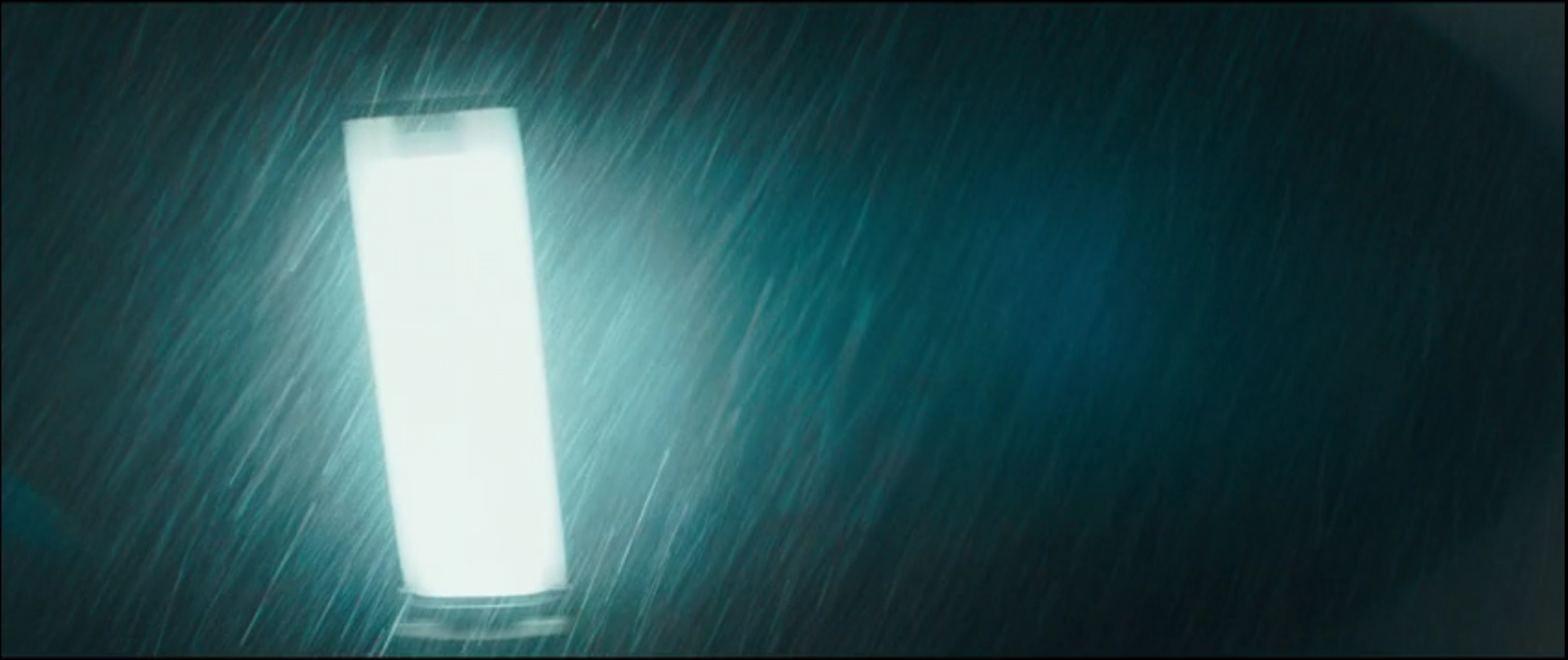
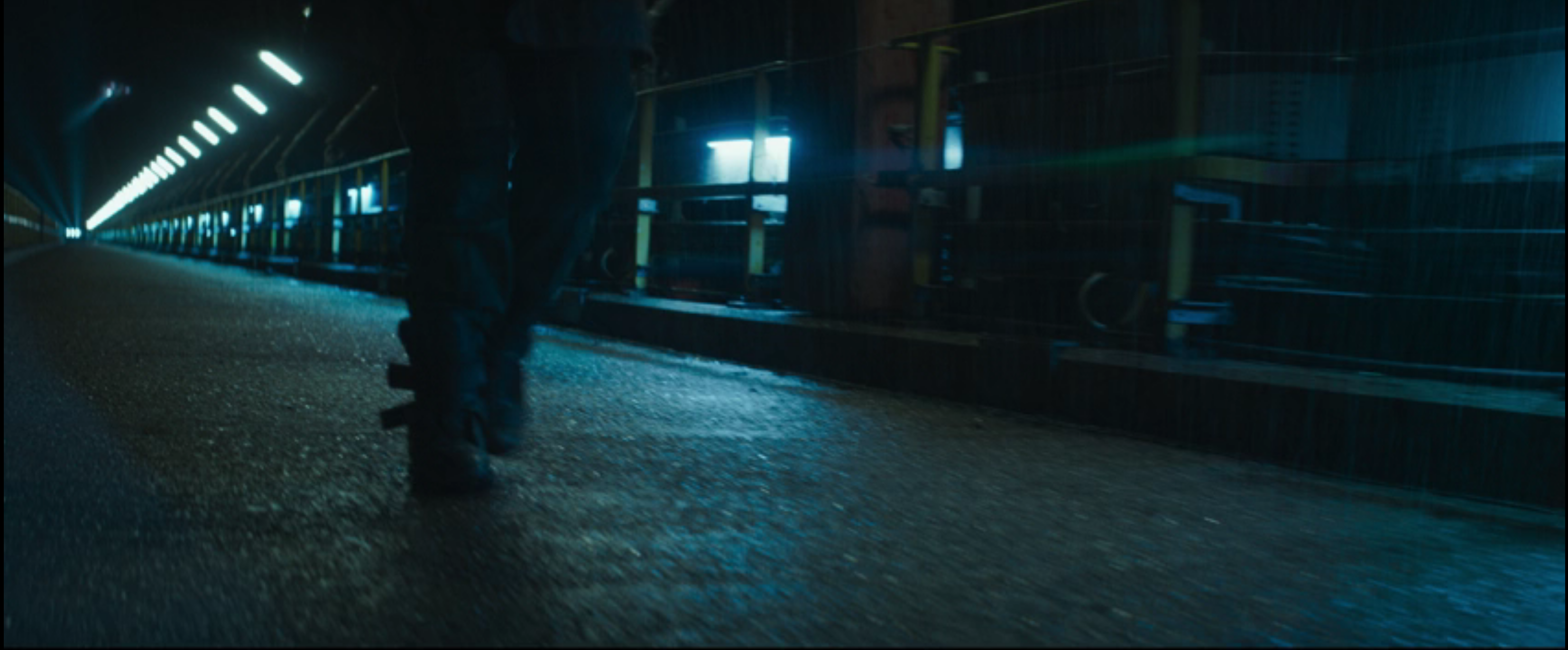
Andor begins with a low angle shot of lights set against a dark and stormy night (Figure 1). As the camera tracks from left to right, new lights appear and disappear. At first the appearances of these lights are punctuated by the score, but as the camera begins to pan to the right the lights and the music fall out of sync. As the camera continues to track and pan, a human figure becomes visible, walking parallel to the lights along a causeway towards a cityscape dimly outlined against the rain and the darkness. A cut to a second shot, at a lower angle, reorients the camera and the viewer. This shot focuses on the hooded figure’s legs set against a perspectival line opposite the one created in the first shot by the convergence of the lights, the causeway, and the camera’s movement. Rather than converging on a point in space ahead of this figure, this second, new perspectival line converges on a point behind him (Figure 2). Another cut presents a wider view of the causeway and the lights vanishing in the distance, of the figure who continues to move towards the vanishing point, and of the cityscape. This third shot offers neither forward nor backward movement but only a crane up that centers the vanishing point in the frame and positions the hooded figure just below it. As the camera settles in space and the shot concludes in time, a legend appears on the right side of the frame. The legend adds to the frame a second organizational scheme (the vanishing point being the first), one that divides it vertically into three unequal sections. The left hand section mainly contains the lights with which we began. The middle, and narrowest, section articulates the convergence of the lights, the street, the camera’s movement, and the hooded figure with the cityscape. The right hand section, again, contains three lines of text set against a darkness barely broken by the distant cityscape: “Morlana One/Preox-Morlana Corporate Zone/BBY 5” (Figure 3).

Figure 1: Andor Season 1, Episode 1 (00:01:07): Streetlight and street darkness.

Figure 2: Andor Season 1, Episode 1 (00:01:16): Legs, lights, and the past.

Figure 3: Andor Season 1, Episode 1 (00:01:34): The future and the past.

Continue reading

Franchise Fictions: Course Materials

Posted in Franchise as form, Teaching, Writing with tags , , , , , , , , , , , on 14 January 2022 by Ben

I proposed a new class for our department last year, the catalog title for which is “Popular Culture, Critical Reading.” That title is intended to be broad enough for other people to teach, important in that the course is offered at the 2000 (or 2nd-year) level and is aimed at non-English majors.

However, I always thought of it as a class that examines the nature of franchise as an object of interpretation and all of the baggage that franchises come with (the nostalgias of different audiences, the OBVIOUS relation franchise has to capitalism and production, the size of many franchises and the shifting nature of the megatexts they produce, and so on).

Continue reading

WandaVision not Television: Franchise on the Small Screen

Posted in Conferences, Franchise as form, papers, Writing with tags , , , , , , , , , , , , , , , on 24 June 2021 by Ben

What follows are my notes for my SFRA talk this past weekend.

WandaVision not Television: Franchise on the Small Screen

So I have been interested in franchise for a while and have been presenting on the subject at SFRA and elsewhere for the past few years. In these presentations and in a few roundtables I have mainly discussed filmic instances of franchise, such as Star Wars Episode VII: The Force Awakens and the Iron Man and Captain America trilogies. My shift here to a discussion of what used to be called television has to do with what seem to me new ways franchises are making use of the medium and our nostalgia for it. Examples of this shift to original serialized streaming content that develop franchise storyworlds at critical moments in the history of a franchise include WandaVision and the Mandalorian and, more recently, The Falcon and the Winter Soldier and Loki. My cautious and perhaps vague thesis regarding these “shows” states that they represent processes within Star Wars and the MCU distinct from older instances of franchise television such as Star Trek: The Original Series or The Next Generation, Star Wars: The Clone Wars, or even Marvel’s Agents of Shield.

Continue reading

Two conference proposals: on WandaVision and The Mandalorian (for SFRA 2021) and on Afropessimism, Afrofuturism, and History (for Imagining the Impossible)

Posted in Conferences, Franchise as form, papers, Writing with tags , , , , , , , , , on 10 February 2021 by Ben

Benjamin J. Robertson

Proposal for SFRA 2021

WandaVision not Television: Franchise on the Small Screen

Recent instances of franchise on the small screen, such as Marvel’s WandaVision and Star Wars’s The Madalorian, demonstrate the challenges scholars of genre and media face when analyzing franchise texts. Specifically, insofar as they participate in older/other media forms, here television but elsewhere film or video games, instances of franchise obscure their participation in franchise itself, a production model that we can trace back to at least the first James Bond films that has now evolved into something more like a narrative form. This obfuscation occurs not on the levels of production, marketing, or consumption. It occurs at the level of meaning and interpretation. As a quasi-narrative forms, franchise is difficult if not impossible to analyze and understand all at once as complete texts (and individual franchises present their own, unique difficulties to critics). At the same time, individual texts within the franchise remain difficult to understand outside of the franchise framework that conditions them whatever meaning they possess.

This paper takes WandaVision and The Madalorian as case studies of the franchise form’s new incursion into television programming in the context of streaming services such as Disney+. Previous instances of franchise on television (such as Marvel’s Daredevil or Star Wars’s The Clone Wars) follow the production models of conventional television programming. WandaVision and The Madalorian challenge such models in several ways. Most importantly, each demonstrates the potential of franchise to incorporate perhaps any aspect of cultural production into itself even as it undermines the conventional limits and affordances of various media. WandaVision remediates the American television sitcom as a container for social conflicts, one that evolves over the course of its lifespan starting with the rather banal narratives of the 1950s and moving through subsequent decades that saw the sitcom form deal with questions of race, gender, sexuality, death, and so on. At the same time, complexities and conflicts specific to the MCU cannot be contained by the sitcom at all and force WandaVision into the meta-discourse of franchise and thus destroy our capacity to understand it or interpret it as television. The Mandalorian remediates its own franchise by way of the toys that have always been at its commercial heart. Individual episodes of the show seem less concerned with advancing an overall franchise narrative (or even presenting new narrative ideas for each episode) than they do with providing backdrops against which action figures, speeder bikes, and sandcrawlers perform the set pieces at the heart of the sort of play nostalgic fans participated in as children. Taken together, and in relation to other new instances of franchise, these shows underscore our need for new interpretive frameworks, new theories of media, and a new concern for monopolies on cultural production. This last concern is no longer simply about one or two corporations that control the production, distribution, and exhibition of texts. It is now a concern that these corporations are coming to own the very forms these texts take.

Benjamin J. Robertson

Proposal for Imagining the Impossible

Afropessmism and Afrofuturism: Re-imagining Fantastika after History

The scholarly discourses on Afropessmism, by Frank Wilderson and Christina Sharpe, for example, and Afrofuturism, by Kodwo Eshun and Alondra Nelson, for example, implicitly and explicitly adopt concepts and structures that derive from the several subgenres of fantastika, especially fantasy, science fiction, and horror. However, insofar as these discourses reject progress (Afropessmism) or seek to rethink the narrative threads that connect past to present and future (Afrofuturism), they also demonstrate the limitations and problems inherent to these subgenres, including fantasy’s nostalgia for a past of plenitude, science fiction’s imagining of a truly novel future that will break with the past, progress, and horror’s dismissal of all narrative structure and meaning. These problems, I argue, derive from fantastika’s origins in the eighteenth and nineteenth century, as described by John Clute, Fredric Jameson, and Carl Freedman, among others. Insofar as fantastika emerges in response to the advent of historical consciousness in the wakes of the bourgeois revolutions in France and North America and of industrial capitalism, it reflects on three basic understandings of history—that history is but is bad (fantasy), that history is and is good (science fiction), and that history is not (horror)—while only rarely reflecting on the historicity of history itself, on the fact that our idea of history was and is historically determined. Now, after the end of the metanarratives of the Enlightenment (Lyotard) and of history itself (Fukuyama, Flusser), fantastika continues to reflect the concerns of those who write and read it even as it undergoes transformations that challenge some of its original tendencies. This paper investigates Afropessimism and Afrofuturism as discourses that adopt, adapt, and undermine the historically conditioned “truths” of fantastika by way of points of view, concepts, and narratives structurally excluded from fantastika by way of the historical moment of its birth and the historical consciousness of that moment.

Remarks for Avengers vs. Jedi Roundtable

Posted in Conferences, papers, Uncategorized, Writing with tags , , , on 4 July 2018 by Ben

Some opening remarks for a roundtable I was just on for SFRA 2018. The topic was Avengers vs. Jedi and mainly focused on the problem of franchise and media consolidation in late late post post modern capitalism or whatever we are calling it these days.

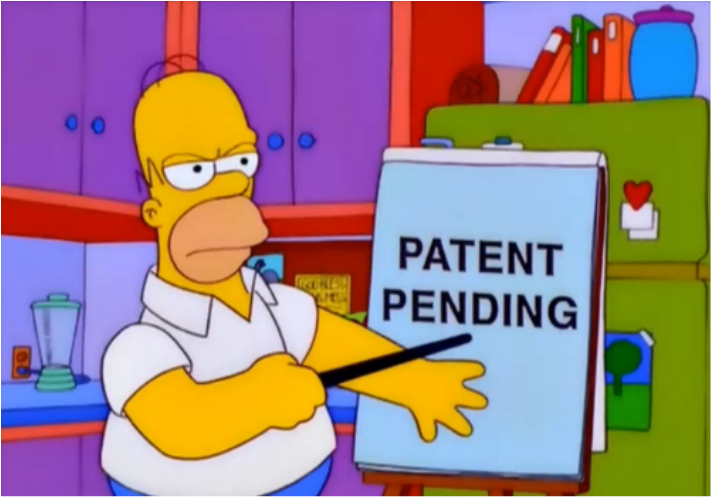
Also, to be clear, I coined the term “naustalgia.”

patent-pending

More seriously, one of the ways I think we might distinguish between Star Wars and the MCU as franchises is by recognizing a difference between the former’s nostalgic logic and the latter’s easter egg logic. Franchises, I think, have to manage an audience’s affective response in order to maintain that audience’s interest in a sprawling storyworld and the media properties that express it. We all know that A New Hope is a key example of the nostalgia film insofar as it referred to eariler media properties such as Buck Rogers and Flash Gordon. I have argued and would continue to argue that, very simply put, the challenge for Stars Wars in the Disney era has to do with producing and managing nostalgia for earlier iterations of the franchise even as it produces and manages novelty. To be clear, I am drawing a distinction between nostalgia for previous but distinct media objects and nostalgia for the media objects that belong to an extant franchise. With this distinction in mind, we can see that the MCU has not had to worry about franchise nostalgia quite yet as it has come into existence and sprawled so quickly—18 going on 19 films in about a decade. There is, of course, nostalgia in it for fans of comics and fans of these characters, but there is no nostalgia yet for past iterations of the MCU (although I can imagine that coming shortly and I wonder what the effect will be). There are, however, easter eggs (and note that I am probably using the term in a somewhat heterodox manner here). Some of these easter eggs are minor in terms of the overall MCU arc but are cool for fans of the comics, such as Howard the Duck’s appearance in the end credit scene in the first Guardians of the Galaxy. I am not sure there is any nostalgia there, but if there is, again, it’s not for the MCU but for some pre-MCU media object. Some of the easter eggs are more significant for an anticipatory quality that becomes clearer in retrospect, such as the appearance of what turns out to be the fake Infinity Gauntlet in Thor. Finally, some of them are tremendously consequential for both their revelation of the present and their determination of the future, such as the appearance of Thanos in a post-credit scene at the end of The Avengers—which also includes a cool but inconsequential easter egg for comics fans, the mention of “courting death” by the Other as he describes the battle with humanity that just took place. (And I would note that the proliferation of end credit scenes is an escalation of the easter egg logic behind the MCU.) I want to keep this short, so I will refrain from theorizing the distinctions between nostalgia and easter egg as logics, but suffice it to say I think that they are at odds with one another in terms of how they manage audience’s affective expectations in relation to the coherence of the overall franchise. And, finally, I will note that one of the reasons Solo is so terrible is that it tries to introduce easter egg logic to a franchise structured by nostalgia, a nostalgia especially complex with regard to the iconic character whose name is in the title despite being, it turns out, an utterly random easter egg.

The Last Jedi’s Anti-nostalgia and Anti-Salvation

Posted in papers, Uncategorized, Writing with tags , , , , , , , , , on 19 December 2017 by Ben

I assume I was the last person to actually see The Last Jedi, or at least the last person who wrote a review of The Force Awakens about the way the franchise is developing and therefore has some sort of intellectual stake in this whole thing to actually see The Last Jedi. As such, I have mainly avoided all of the reviews and discussions of the film. So, if I say anything that’s been said or seem redundant to overall conversation, oh well I guess.

In my review of TFA for Science Fiction Film and Television, I made a case for interpreting Star Wars as a franchise. Plenty of work has been done to understand the nature of the media franchise in terms of world-building, production models, economics, multi-platform distribution, etc. However, less work (basically no work?) has been done to address the difficulty of how to interpret a given franchise, especially given the fact that every major franchise (Star Wars, Star Trek, Dr. Who, the MCU, Harry Potter, The Lord of the Rings, etc.) is unique unto itself, developing its own internal logics according to manifold pressures both “internal” to it (the foundational narrative, the physics of the story world, etc.) and “external” to it (intellectual property law, the vagaries of corporate ownership, the visions of multiple creators, fan expectations, etc.). Needless to say the distinction between internal and external is blurry at best, and these pressures combine and re-combine in ways that are impossible to fully appreciate. In any case, while we have seen a lot of discussion of what happens in a franchise such as Star Wars as it expands across films, television, video games, novels and short stories, comics, toys, etc., we have not really developed a way to “close read” the resulting narratives in their complex relationship to one another.

In my review essay of The Force Awakens I suggested a focus on worlds in the context of the production history and reception of the Star Wars franchise. (Also, note that Gerry Canavan and I have just completed work on a special double issue of Extrapolation, on the question of “Mere Genre”, which attempts to think about how we, as critics, might deal with massive text sets of varying quality, such as Dragonlance, Star Wars and Star Trek, Blondie (the serial comic), Sweet Valley High, The Hunger Games, and Game of Thrones.) In my essay, I make a case that TFA had to clear the slate for future Star Wars films–hence its repetition of so many devices and plot lines that Star Wars fans have come to expect from the franchise (another Death Star, another hero’s journey, etc.). Moreover, TFA had to satisfy the contradictory expectations and desires of at least three groups of fans: the “original” fans of episodes IV, V, and VI, who very often hated episodes I, II, and III; the generation of fans who grew up with episodes I, II, and III and who may not have hated them because they were givens of a franchise rather than intrusions into one; and the fans who would first encounter Star Wars through TFA. there are other groups of course, including the hardcore fans of what are now know as Star Wars Legends (the former expanded universe, which has become non-canonical in the wake of Disney’s acquisition of the franchise). Likewise, every generation of fans is internally diverse. Nonetheless, I think that the logic holds: Disney and Abrams had to create a film that could allow the franchise to move forward and maintain/revive older fandoms while creating new ones. Oh yeah, it also had to do all of this with an aging cast from the original trilogy, not all of whom were happy to be a part of the next generation.

Continue reading