Archive for writing

Chapter from my dissertation: The Declaration of Future Democracy

Posted in Writing with tags , , , , , , , , , , , , , , , , , , , , , , on 3 March 2013 by Ben

Another text from the archives, a more complete and wide-ranging version of the MLA paper I posted last week. This was the dissertation chapter form which that paper was culled. This was the third chapter in the diss, following from a long discussion of Octavia Butler’s Kindred in chapter one (published in somewhat different form in Science Fiction Studies) and a discussion of politics and science in the context of Stuart Kauffman’s theory of complexity in chapter two (published in Configurations–my first ever publication! Thanks Jim Bono, Hugh Crawford, and Mark Hansen!). Chapter four dealt with the problem of the monster and offered a conceptualization of wonder.

For the most part, I don’t like my dissertation as a dissertation. It’s all over the place, and this chapter is sort of a microcosm of that all-over-the-placeness (it’s a word). I do like a lot of things I say, and I do like my attempt to draw together theories of democracy and violence from Agamben, Schmitt, Benjamin, Deleuze, Derrida, and others with literature by DeLillo, Coupland, Gibson and others. Also here is Battle of Algiers and Syriana as well as Robert Baer’s See No Evil, upon which Syriana was based. Oh, also: Thoreau and the Declaration of Independence.

I appear to myself, six or seven years later, a much less mature writer. So many block quotes here, which appear to me now as a mask for misunderstanding. I could not discuss or deploy these texts effectively, so I let them speak for themselves far too often and only addressed what I wanted to. In any case, not sure my readings of these texts hold up under scrutiny. Rather, I am pretty sure that my readings of individual texts hold up (simple as they are), but that these texts don’t play as nicely with each other as I might want them to, or believe them to. I am not sure how I feel about that now. I find being RIGHT so uninteresting, and abhor debates about what so-and-so REALLY means a waste of time. As such, if these texts don’t play well together, on some deeper level that only a proper close reading can find and address, then I am not sure I care.

The Declaration of Future Democracy

Prudence, indeed, will dictate that governments long established should not be changed for light and transient causes; and accordingly all experience hath shown that mankind are more disposed to suffer while evils are sufferable, than to right themselves by abolishing the forms to which they are accustomed. But when a long train of abuses and usurpations, begun at a distinguished period and pursuing invariably the same object, evinces a design to reduce them under despotism, it is their right, it is their duty to throw off such government.1

—The Declaration of Independence


Revolution.

In “Civil Disobedience,” Henry David Thoreau reiterates Jefferson’s claim that when the situation warrants, citizens have the right to change their government: “All men recognize the right of revolution; that is, the right to refuse allegiance to, and to resist, the government, when its tyranny or its inefficiency are great and unendurable” (389). However, what Thoreau is able to accomplish in his essay is not simply an affirmation of the right to revolution, but an expansion of Jefferson’s argument. For Thoreau, while political processes must include revolution (or at least its possibility), he also understands that not all decisions involve the dissolution and recreation of government. Thus the right to revolution becomes for him the right to make political decisions, specifically the right to decide upon slavery and the Mexican-American War. The problem, of course, is that while “all men” might recognize the “right to revolution” cum the “right to decide,” they will not all agree upon the proper moment for such decisions or even what decisions should be made and how.

To overcome this problem, democracy asks citizens to express their desires first in deliberation and then through their vote, with the majority awarded the right to make decisions (or the majority’s decision being enforced). However, for Thoreau, the ends reached via this method (what Kaufmann would call consensus) are not satisfactory:

After all, the practical reason why, when the power is once in the hands of the people, a majority are permitted, and for a long period continue, to rule is not because they are most likely to be in the right, nor because this seems fairest to the minority, but because they are physically the strongest. But a government in which the majority rule in all cases can not be based on justice, even as far as men understand it. Can there not be a government in which the majorities do not virtually decide right and wrong, but conscience?—in which majorities decide only those questions to which the rule of expediency is applicable? Must the citizen ever for a moment, or in the least degree, resign his conscience to the legislator? Why has every man a conscience then? I think that we should be men first, and subjects afterward. It is not desirable to cultivate a respect for the law, so much as for the right. The only obligation which I have a right to assume is to do at any time what I think right. (386-87)

The important aspect of Thoreau’s claim is not the notion of “might makes right” (what Jacques Derrida calls “the reason of the strongest”2). Thoreau does not mean here simply that a majority of citizens can forcefully execute their will upon a minority, as in a physical confrontation. What is important in Thoreau’s argument is the implicit claim that decisions cannot be rightfully made on the basis of the deliberation and agreement of the majority, but through an appeal to conscience. In that conscience is for Thoreau only found in the individual and never in groups (unless the groups are comprised of conscientious individuals acting in their capacity as conscientious individuals), the decision making process he advocates is, it would appear, fundamentally undemocratic. It is the purpose of this chapter to explain what Thoreau means as well as to explain the necessary non-democratic aspects of the democratic process.

We should not misinterpret what Thoreau means by “conscience,” or, rather, underestimate such a faculty. While conscience here retains its common meaning of a “moral sense” by which we determine right from wrong, it is not relativistic. The last line of the above passage informs this reading. There Thoreau seems to state that obligations are taken on through a choice, well-informed or otherwise. However, in the previous sentence he contrasts “law” with “right.” If we understand “right” in the context of chapter two, as a power coextensive with its exercise, then we must also understand that such rights are not simply taken on or left aside through a choice, but are obligations in the strongest sense of the term. So to follow conscience, or more appropriately to have a conscience, is to always do what one thinks is right. More specifically, to have a conscience is to use that conscience to the extent that one cannot do anything but what is right.

The difficulty for democracy, according to Thoreau, is that while individuals can and do make use of their consciences, groups of people, taken in total, lose their ability to distinguish between right and wrong, a fact that is demonstrated during voting procedures.

All voting is a sort of gaming, like checkers or backgammon, with a slight moral tinge to it, a playing with right and wrong, with moral questions; and betting naturally accompanies it. The character of the voters is not staked. I cast my vote, perchance, as I think right; but I am not vitally concerned that that right should prevail. I am willing to leave it to the majority. Its obligation, therefore, never exceeds that of expediency. Even voting for the right is doing nothing for it. It is only expressing to men feebly your desire that it should prevail. A wise man will not leave the right to the mercy of chance, nor wish it to prevail through the power of the majority. There is but little virtue in the action of masses of men. When the majority shall at length vote for the abolition of slavery, it will be because they are indifferent to slavery, or because there is but little slavery left to be abolished by their vote. They will then be the only slaves. Only his vote can hasten the abolition of slavery who asserts his own freedom by his vote. (392)

That there is an election day once per year does less to afford right action than it does to obfuscate the structuring of action in a specific form. Along with Thoreau, thinkers as historically and politically diverse as Alexis de Toqueville, Carl Schmitt, and Derrida have made clear that voting is not what is important for democracy. What is clear, and here we must extend Thoreau’s discussion of this issue, is that voting, while necessary, is action in a form dictated by the state. It is rationality applied to human action, the naturalization of what Thoreau calls conscience. In that it is the design of a group rather than an individual, it is not guaranteed to be in the right. In that it operates according to juridical structures, it is manipuable in the manner of the history described in chapter one. I do not mean to suggest that elections can be bought or that elections are fraudulent (although both cases are sometimes true). Rather, what I would like to consider is the manner in which the juridical impinges upon the natural, how law (and the representations surrounding it) constrains right.

Most importantly, what I would like to offer is an analysis of the manner in which right must be brought to bear in the name of law, how juridical structures, how democratic institutions, can only ever be effectively democratic by allowing that which is not democratic to influence their behaviors. This statement is no doubt one that will cause concern, and I would like to be able to address it immediately. However, in order to do so effectively I will first turn to a further discussion of right in the context of democracy in order to demonstrate the tenuous legitimacy of democracy itself as well as the problematic legitimation it affords.
Continue reading

Everything looks worse in black and white: Graphic Violence in From Hell: My Proposal for ROMOCOCO:

Posted in papers, Writing with tags , , , , , , on 1 March 2013 by Ben

It’s not quite BI-MON-SCI-FI-CON (“Be there and be square!”), but ROMOCOCO (The Rocky Mountain Comic Convention) has a great name. and now it has this proposal to consider.

Everything looks worse in black and white: Graphic Violence in From Hell

Benjamin J. Robertson

In the early 1970s, I recall looking through HBO’s monthly guide and discovering that among the reasons a film might be rated R was something called “graphic violence.” My parents explained that graphic violence involved a lot of blood. For years I understood the word graphic to mean something like “gratuitous and visual.”

From Hell is an unquestionably violent text and a certain amount of this violence seems to be graphic in the manner of those movies on HBO after the kids are sent to bed. Absent, of course, in From Hell’s black-and-white artwork, are the red of the blood and the sheen of the guts of Sir William Gull’s victims. And while HBO’s definition of “graphic” applies to this text, its another form of “graphic violence” that is all the more notable in it.

This paper investigates the manner in which From Hell’s black-and-white artwork interacts with, underscores, and augments the text’s themes of violence and history. The most violent aspect of the text is not its portrayal of the relentlessness of William Gull but the relentlessness of its representational strategy. Moore and Campbell offer no respite from the onslaught of rough black-and-white images, images which assault the reader with their sameness and with their inability to render any clarity. Far from offering the simplicity or morality that “black and white” implies (following from, for example, the nostalgia we feel for the image of the 1950s given us in the television reruns from that era), From Hell instead offers the past as an elaborate sketch. Indeed, From Hell appears to the reader as more of a study for some as yet incompletely imagined work than it does a finished product.

The Illegible and the Interface

Posted in papers, Writing with tags , , , , , , , , , , , on 24 February 2013 by Ben

Another conference paper (given two or three times) from the vaults that never went anywhere more productive. I don’t know what happens at the end. So many of these papers just sort of trail off. The session must have been starting and I had to “finish” writing.

————————————————-

Derrida, in Dissemination: “a readability without a signified (which will be decreed to be an unreadability by the reflexes of fright)” (253)

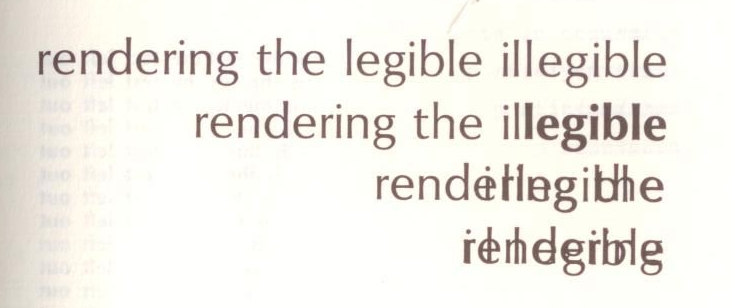
Bremer - Untitled

Claus Bremer – Untitled

In an early critical evaluation of concrete poetry, RP Draper writes:

In European printed language it is an automatic assumption that letters forming words are separated by space from other letters forming words, that these letters march across the page from left to right, and that the lines so formed are strictly parallel and progress downwards at equal intervals. Concrete poetry plays upon these expectations, but itself takes nothing for granted.

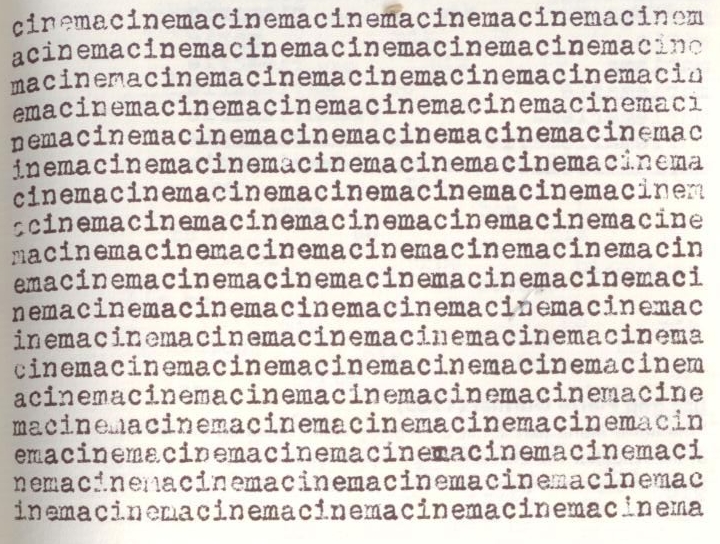
Among his many examples of this “taking nothing for granted, Draper notes that the spacing between words may be erased, as in Ilse and Pierre Garnier’s “cinema”, shown here

Garniers - cinema

Ilse and Pierre Garnier – “cinema”

[Sorry for the quality of the scan]

Continue reading

MLA 07 Paper: Sameness or, the Declaration of Futuristic Democracy

Posted in papers, Writing with tags , , , , , , , , on 24 February 2013 by Ben

Another one from the vaults. Although I am certain that I am making mistakes in my readings of the various thinkers I engage here, I am nevertheless rather proud of this paper, which was easily the most well-received of any paper I have ever given. It is also much more coherent. I must have put a lot more effort into conference papers back then.

————————————-

My plans for this paper initially included a formulation of a theory of declaration, a means by which to break the Sameness of the endless present, a means of destroying extant relationships, especially those that involve asymmetrical power. In fact, this declaration was to posit a means by which asymmetrical power can become symmetrical, much in the manner that Thoreau claims that a single just man can stand up to the power of the state and disrupt its hegemony. However, what I discovered in my thinking was that, far from interrupting Sameness, declaration, as it is understood historically and in the context of documents such as the Declaration of Independence and the Declaration of the Rights of Man and Citizen, far from being that which interrupts Sameness and inaugurates the future, is that which produces Sameness. It is thus, in my argument, an agent of the futuristic, a false future that is merely an extrapolation from the present. This paper is about this issue.

Throughout his work Giorgio Agamben returns to Aristotle’s conception of the ground, that formulation through which things are categorized. As he puts it in The Open, in reference to a passage from De anima, “Here we see at work that principal of foundation which constitutes the strategic device par excellance of Aristotle’s thought. It consists in reformulating every question concerning ‘what something is’ as a question concerning ‘through what something belongs to another thing’” (14). Following from his attention to the Aristotelian ground, Agamben is concerned in much of his work on biopolitics with the question of inclusion and exclusion and the role it plays in the modern nation-state.

Similarly, Carl Schmitt turns to Aristotle in the preface to the second edition of The Crisis of Parliamentary Democracy, where he first notes that the notion of government by discussion, parliamentarianism, belongs not to democracy but, rather, to liberalism, a concept that Schmitt distinguishes from democracy. Writes Schmitt, cribbing from Aristotle’s Politics, “Every actual democracy rests on the principal that not only are equals equal but unequals will not be treated equally. Democracy requires, therefore, first homogeneity and second—if the need arises—elimination or eradication of heterogeneity” (9). Building upon his claim, Schmitt populates this equation with what, for Agamben and this paper, are problematic terms when he states that a “democracy demonstrates its political power by knowing how to refuse or keep at bay something foreign and unequal that threatens its homogeneity” (9). Schmitt would elaborate this distinction between the interior that is equal and the exterior that is not in The Concept of the Political, where he claims that the primary political opposition is that between friend and enemy. Agamben’s work marks a decisive turning away from Schmitt’s categories characterized by a reading of Aristotle that demonstrates the primacy of the formulation of the ground rather than the appearance of any particular instantiation of that formula. The significance of this turning away will become evident in the course of this paper.

Continue reading

A paragraph from my essay on Watchmen, about Dylan, superheroes, and nostalgia

Posted in Writing with tags , , on 20 February 2013 by Ben

Even as it reveals the always already fragmented nature of the ideal nostalgia takes as its object, Watchmen’s preoccupation with Dylan underscores its own, ironic perhaps, nostalgic dimension. The novel makes use of three Dylan lyrics. The first two, from “Desolation Row” and “All Along the Watchtower,” Moore and Gibbons explicitly attribute to their respective sources. (I shall have more to say about “Desolation Row” below.) They serve as epigraphs for two of the novel’s twelve chapters, and therefore operate outside of Watchmen’s fictional world, as if perhaps Dylan himself never existed there (indeed, he is never referenced by name in the story itself). Much as the novel posits an American nostalgia for the simplicity of superhero morality, these references to Dylan to suggest a nostalgia for Dylan himself, for a time when Dylan made sense, or perhaps for a superheroic Dylan who could make sense of the world by simplifying its problems into anthemic songs. The novel seems to long for a world which never existed even as it demonstrates the fact that, had superheroes existed, they could not have created a better future.

some thoughts on sf, horror, fantasy, genre, technology, magic, and other made up stuff

Posted in Here at the End of All Things, Writing with tags , , , , , , , , on 9 January 2013 by Ben

No time to write today as I have been prepping for the coming term, taking notes on The Natural and The Wind-up Bird Chronicle. Thinking about the latter in the context of my class on the Nigh Fantastic brought me back to some thoughts I have had on the connections amongst the genres of SF, fantasy, and horror. I had been discussing these connections with a colleague last year and wrote up the following explanation. I don’t pretend that these are perfect definitions–all definitions of genre are fraught with inconsistencies. They are just speculations, useful for my current project on genre, media, and history in which I am thinking about the ways that these three genres allow us to imagine the future. Specifically, I am thinking about Stiegler’s notions of disbelief and discredit and how sf creates each and how fantasy might, if read according to terms other than those that derive from sf, foster belief rather than merely suspending its opposite. In any case, in lieu of actual writing for the day, here are some thoughts. I was specifically addressing my colleague’s concerns about the unreality of magic and therefore the problematic and unuseful nature of fantasy.

—————————-
Bataille cites Breton (this is in The Accursed Share vol 2) on the need of some men to create an authentic humanity that overcomes the inauthentic humanity that precedes it. keep this in mind.

so, my thinking on these three genres (which i won’t claim to be perfect, nor is it total given how slippery genre is) goes like this:

  • sf is about what cannot happen in the reader’s world but plausibly could (with the recognition that this plausibility derives from a certain episteme, probably related to a Hegelian notion of progress).
  • fantasy is about what cannot happen in the reader’s world and doesn’t. that is, the reader *knows* it cannot happen (again, where this knowledge is conditioned by an epistemological ground).
  • horror is about what cannot happen in the reader’s world and shouldn’t. i think for this reason we see more slasher/torture porn now than Lovecraft-style horror. the latter does not frighten us because we have no strong understanding of knowledge and it’s practices, thus we cannot be frightened by the revelation that we know nothing (which is the primary horror of At the Mountains of Madness). thus what “should not* happen in the reader’s world is reduced to the gruesome, rather than the existential. this may be why Prometheus fails–too much of the former with little of the latter. the existential fear is what is great about the first and even the second Alien film.

the three are thus connected by this “cannot happen” and disconnected by way of our understanding of possibility. further, we can also consider the genres with regard to the attitudes of characters in the narratives. in sf, characters tend to accept the existence of whatever technology (which we accept with them as possible, if not actual). in fantasy, characters tend to accept the reality of magic (although often this acceptance is not primary; in many fantasy texts, magic has only reappeared for the main characters, who then struggle with this reappearance). in horror, characters do not accept what happens in much the manner that we do not accept it as possible in our world, for the simple fact that it *should not* be possible. i can’t push much harder here without these neat distinctions falling apart, but i will mention a couple of things.

  • first, fantasy and sf have a connection insofar as characters accept as real what is for us impossible, although there are differences in how long this acceptance takes.
  • horror and fantasy connect insofar as they both deal with things that cannot happen for us. the difference between them seems to be in the way they deal with the past. whereas fantasy has the wizard, who may be a crank but tends to be respected, horror has the gypsy or similar character, who is not so much a crank as shunned altogether. both characters warn the present about the supernatural (Gandalf warns Middle Earth about Sauron, the gypsy about the werewolf or whatever). more on this in a second.
  • horror and sf connect in that they both posit a rational world to begin with. sf deals with an extrapolation of the rational into a superrational, whereas horror deals with the revelation that the rational was only ever a mask for something else. the stripping away of the rational is horror.

so this all leads to a few more points that might begin to address concerns about magic, in the context of the Breton above. all three genres, it seems to me, deal in some way with questions of knowledge, history, and humanity–which are terms that are, in some sense, closely connected with one another. so try on this alternative explanation of what the three genres do:

  • sf deals with the forward movement of history and the possibility of an authentic humanity in the future. the path to this humanity is knowledge. of course, much sf finds that knowledge is problematic and that too much an lead to decadence or destruction or something equally bad.
  • in fantasy, the authentic humanity is in the past. much fantasy takes as its starting point a present that can no longer accomplish the great works of the past (Gondor cannot do magic to counter Sauron, whereas 3000 years earlier the Last Alliance of Men and Elves could defeat him in open battle; Aragorn is the descendant of Men, but is perhaps the last of them; etc.). the past is a time when magic was understood, when it was useful and could do things. in the present, magic, if there is magic, is poorly understood, or understood only by anomalous mystics who seem to be utterly ahistorical. thus magic becomes magic through decadence. in this way, fantasy can be understood as the *future* of science fiction, a time in the future after the decadence that sf posits as the outcome of rationality in which technology is no longer understood and therefore becomes magic.
  • horror, finally, is about the present. authentic humanity has been achieved and the rational world rules all. however, that authenticity is then challenged by a discovery (as in At the Mountains of Madness or, for that matter, Prometheus) that reveals rationality for a facade. whereas sf would deal with the same sort of thing as the outcome of a rational project (even if that project leads towards irrationality at some point), horror posits something completely unexpected, to the point of being impossible. that discovery is not subject to falsifiability, is not a failed experiment so much as something that happens outside of the context of failure/success (a binary of science, both terms of which are equally scientific and rational).

so, sf is about the future becoming a kind of past–insofar as knowledge can lead to decadence. fantasy is about the past becoming a sort of future–in which rationality is lost due to exactly that sort of decadence. horror is about the present opening onto both a past (the return of the repressed, what rationality had to always ignore and obfuscate) and a future (in which what might be repressed is humanity itself). it seems then, to me, that magic and technology are not so far away from one another. in sf tech might become magic; in fantasy, tech *has* become magic (and note here that for Mieville tech and magic are very close to one another insofar as he situates them both within political economy, rather than positing magic as a force that is always outside and forever unexplained). horror might not deal with this binary at all, but rather might be about a challenge to knowledge in any form. for a world more comfortable with sf, horror is the disruption of rational knowledge, the introduction of that which cannot be known into knowledge. for a magical world, horror is less this epistemological problem than an ontological one. the character in fantasy knows that what we would call the supernatural exists, but that knowledge is hardly comforting as all it provides is the knowledge of what might happen to that character (she could lose her soul, be enslaved, etc.). these sorts of horror do bleed over (fear of the bomb in sf; coming to know of a darker magic heretofore unknown in fantasy).

so, in short, magic is the past and future of technology and thus fantasy is the past and future of sf. horror is the generic element necessary to introduce this pastness or futurity.

to paraphrase Arthur C. Clarke: any insufficiently advanced magic is indistinguishable from technology.

Something is better than nothing: more Watchmen (Page a Day day 7)

Posted in Page a Day, Writing with tags , , , on 8 January 2013 by Ben

The following is part of my Page a Day project and some rough writing from my forthcoming essay on Watchmen, music, and nostalgia.

Another lite day of writing–although I got tons of work done today. I was going to skip this altogether, but I am glad I did something, however litter. This follows directly from what I wrote yesterday.

The contrast between these images of death and the self-assured, good-natured interviewee of the interchapter that immediately follows is jarring. In the interview Veidt discusses his past as a costumed hero, his conflicts with his peers (especially that with the Comedian, a man Veidt refers to earlier in the novel as “practically a Nazi”), and his interest in electronic music. He comes across as a humanitarian and, perhaps above all else, as a sort of “sensible liberal”—a believer in social justice but a hard nosed businessman nonetheless. In short, he appears to be the sort of person who had been, in the historical United States, a hippie in the 1960s before finishing college and then becoming a captain of industry. (He had even been a world traveler upon coming of age and, subsequently, a student of Eastern religions and ancient mythology.) However, we know that in the 1960s Veidt was a costumed hero, following in the footsteps of others, especially Dr. Manhattan. Again, Dr. Manhattan is perhaps the reason that there is no counterculture and therefore no hippies. What’s strange, or perhaps not so strange suggests Watchmen, is that despite not being a hippie in the 1960s, despite having no Bob Dylan to draw inspiration from and then reject, Veidt becomes a businessman and himself begins to draw upon and deploy imagery very close to Nazi propaganda. To be clear: despite the presence of superheroes, and despite the absence of the counterculture, America winds up, in the 1980s, very much as it would in reality.

A review of I Must Not Think Bad Thoughts: Drive By Essays on American Dread, American Dreams

Posted in Writing with tags , , on 7 January 2013 by Ben

I wrote the following as a review that will, it seems, never appear anywhere else. I find it hard to believe that it can be so difficult to place a review, but there you are. I won’t get into the specifics, but some journals suck. Anyway, here is the review. (Note: Minnesota provided me with a gratis copy of the book, but my understanding of that provision was that it was not contingent on an actual review. I wrote the review because I enjoyed the book and wanted to discuss it.)

by Mark Dery
University of Minnesota Press, Minneapolis and London, 2012
336 pp. 15 b/w illus. Trade, $24.95
ISBN: 978-0-8166-7773-3.

We sense Mark Dery’s presence throughout I Must Not Think Bad Thoughts, but it’s in “Cortex Envy,” the collection’s final essay, that his subjectivity is clearest. Earlier in the book, we glimpse Dery as a former high school classmate or cultural tourist, but mainly he remains there an invisible, contemporary Virgil, showing us what lies beneath and behind the façade of Disneyfied Americana that precludes our acknowledgement of this beneath and behind.

Dery frames this final essay with a discussion of his submission to an adult IQ test, an ordeal he undergoes partly because he wants “to banish the spectre of unfulfilled promise” he feels as his parents’ legacy to him and “partly because guinea-pigging yourself makes for good stunt journalism” (p. 268). Despite the fact that the essays that comprise I Must Not Think Bad Thoughts are, rather than journalism, essays, this late moment is crucial for understanding Dery’s predicament: writing within and for a culture whose shifts, despite arriving faster each day, possess, to we the affectless, less and less consequence.

Dery tells us that the Verbal Comprehension subtests (on which he scores high) of this IQ test include a quiz on cultural literacy. Dery demonstrates his own cultural literacy throughout the book. It’s best moments are often those in which he cuts to the heart of the matter with an erudite one-liner whose resonances exist in gross disproportion to the number of words he uses to create them. Early in the text he approvingly notes how Camille Paglia “comes to any firefight with a speedloader full of zingers,” (p. 30) before dispensing his own. He describes Lady Gaga as looking “permanently agog, like Paris Hilton after a ministroke” (p. 36); Imus as “Rooster Cogburn reading The Turner Diaries” (p. 57); self-help guru Anthony Robbins as “Saturday Night Live’s ‘Unfrozen Caveman Lawyer’ reading from Mark Leyner’s Et Tu, Babe” (p. 170); and the all-too-real Church of Euthanasia as “God’s revenge on Operation Rescue, in a universe ruled by Abbie Hoffman” (p. 241). No doubt anyone who might read Mark Dery possesses the cultural literacy to understand the what of many of these references, but how many, through no fault of their own, grasp their depth? Moreover, what of the people who don’t even grasp the what as yet?

Perhaps most importantly we might ask if these zingers in fact teach us anything or if, rather, we simply wish that they could. After all, doesn’t Paris Hilton already look like Paris Hilton after a ministroke? Does Lady Gaga add anything here?

I Must Not Think Bad Thoughts is not simply a set of zingers, nor are these zingers the most important aspects of the book. The book is, however, something of a throwback to a style of writing, the essay—as practised by a Twain, Mencken, or Sontag—that seems increasingly less relevant today for the fact that cultural literacy, while still very much alive, can no longer be understood as something centralized or common (if it ever was). We have the meme, the viral video, etc., but these things are so many, so ephemeral, and so difficult to simply discover (there are lots of sites on the Internet, after all), that no two people are likely to have knowledge of the same ones even within a relatively narrow American context.

And in the face of this shift, Dery gives us the essay, a form of writing that came into its own alongside our modern conception of the human subject and all the centrality it entails. A Bacon or a Montaigne might welcome these essays as essays (even as they remain perplexed—try explaining the humorous aspects of fascism, or simply fascism, to the author of The New Atlantis). At the same time these are new (drive-by) essays for a new age. They are occasional, yes, but not in the manner we might expect. Dery rarely references 9/11 or our reactions to it, nor does he spend much time on the evangelical right. They’re there, but to Dery they are either obvious in what they tell us about American magic and dread or they are not what’s important. Through these personal essays—personal in that their subject matter is what caught Dery’s eye and are, therefore, what he can best read for us—Dery shows us the consequence of the apparently small and therefore truly hidden. In that, his cultural literacy remains valuable, especially to a culture in which literacy itself, once a standard of education, has become so varied.

“There is no dark side of the digital really”: My proposal for The Dark Side of the Digital

Posted in Page a Day, Uncategorized with tags , , , , , , on 6 January 2013 by Ben

Here is my (late as it were) proposal for the upcoming Dark Side of the Digital Conference. (edit: I’m calling this my page of writing for the day, even if it’ snot quite a page.)

There is no dark side of the digital really”

Benjamin J Robertson

In a recent blog post, Jussi Parrika suggests that we should read the “dark” in “dark side of the digital” in terms of “the dark side of the moon” rather than “dark side of the force.” Instead of the evil or malevolent “side” of digitality we should, with Pink Floyd, address the fact that “There is no dark side of the moon really. As a matter of fact it’s all dark.”

These two approaches to this conference theme are not at all at odds with one another. This paper argues that among the darkest (as in the force) aspects of the digital is its darkness (as in the moon) by design if not by nature. That is, the digital is closed to us, an inhuman space much in the manner that Galloway and Thacker suggest that networks stand opposed to humanity. Drawing from Galloway and Thacker—as well as upon Stiegler’s notions of default, disbelief, and discredit—this paper describes the dark side of the digital through nine short discussions:

  • Speak to Me: when we communicate through digital tools, what else do we communicate with?
  • Breathe: the digital gives us so much room, but none in which to pause.
  • On the Run: as in “on the digital”: the pharmacology of speed.
  • Time: history and futurity in the age of hypersynchronization.
  • The Great Gig in the Sky: where is the cloud?
  • Money: not too much credit but too much discredit—no investment where no belief.
  • Us and Them: there is no us and no them—the digital has neither “side” nor “sides”.
  • Any Colour You Like: the perils of choice; hyper-demography—all content directed to the individual.
  • Brain Damage: how damaged? is the digital now the default?
  • Eclipse: the end of the Enlightenment, even the parts we “like”, such as privacy.

And more Watchmen (page a day day 5)

Posted in Page a Day, Writing with tags , , on 6 January 2013 by Ben

The following is part of my Page a Day project and some rough writing from my forthcoming essay on Watchmen, music, and nostalgia.

Not a great day for writing, but here is something. Some of this is the same as yesterday (the first two paragraphs), but I think I have found the thread: 1) deal with Adrien Veidt, nostalgia, Nostalgia (the cologne), and Veidt’s weird idealization of the past and how it connects to Nazism; get into Dylan and the way “The times they are a-changin'” and “Desolation Row” frame the novel and especially the way that “Times” connects with Veidt and his cologne); get into the fictional music in the novel and its apparent connection to fascism; bring it back to Dylan who may not exist in the world of the novel because of the way the counterculture failed to get off the ground or find traction with the public in the wake of the US victory in Vietnam).

In any case, here it is:

This essay discusses the intersection of music and nostalgia in Alan Moore and Dave Gibbons’ Watchmen, a graphic novel published in serial form from September 1986 through October 1987. Watchmen reimagines the United States of the mid-1980s and late Cold War. That US is a nation that has repealed the 22nd amendment to its constitution to allow Richard Nixon to run for (and win) a third term (and a fourth). This alternate history was made possible by Dr. Manhattan, the one “costumed hero” amongst the novel’s menagerie of superheroes with actual superpowers—superpowers that led to an American victory in Vietnam under Nixon.

As a result of this victory, the counterculture of the 1960s celebrated and deplored (depending on one’s point of view) for its resistance to Vietnam and the military industrial complex, seemingly fails to impact the public imagination of Watchmen’s ersatz America. For example, while there are several references to historical musicians such as Elvis Presley, Bruce Springsteen, and Devo within the novel’s world, the most explicit references to the music of the counterculture of the 60s, here the lyrics of Bob Dylan, come in the epigraphs to two of the novel’s chapters and in advertising copy for a fictional cologne, Nostalgia by Veidt. I will turn to Dylan in a moment, but for now suffice it to say that the novel at once celebrates Dylan as a prophet of the historical counterculture and deconstructs simplistic understandings of his music that reify him as such. Without him, the novel suggests, popular rock music becomes merely the province of hoodlums and takes on a fascist bent, as made clear by the two bands that perform at Madison Square Garden in the novel’s climactic moments: Pale Horse and Kristallnacht. I shall return to this concern later when I focus on fascist and Nazi imagery in the novel and connect that imagery to the conflict between progress and nostalgia at the novel’s center.

For while the novel’s narrative moves inexorably toward this concert and the destruction that occurs simultaneously with it, Dylan, more than any other musician fictional or historical, informs Watchmen’s themes. The novel’s first chapter, “At midnight all the agents,” takes its title from a lyric to 1965’s “Desolation Row,” which also provides the chapter with its concluding epigraph: “At midnight all the agents, and the superhuman crew/Go out and round up everyone that knows more than they do.” Likewise, a later chapter takes its own title, “Two riders were approaching,” from 1967’s “All Along the Watchtower.” A longer excerpt of this song’s lyrics also appear as an epigraph at the end of this chapter: “Outside in the distance, a wild cat did growl, two riders were approaching, the wind began to howl.”

I will begin with the novel’s final reference to Dylan, less explicit than the two just mentioned. Where the lyrics to “Desolation Row” and “All Along the Watchtower” are attributed to Dylan, the title to “The Times They Are A-Changin’” appear unattributed and very slightly altered as advertising copy for a fictional cologne: Nostalgia by Veidt. The advertisement in question appears in a sort of interchapter the follows the narrative section of chapter eleven. After each of the novel’s chapters, save chapter twelve, appear various fictional documents—psychiatric case files, autobiographies, history, etc.–that provide backstory for characters and events. This interchapter is an interview conducted by a reporter from a fictional left-wing newspaper, Nova Express. The subject of the interview is “the world’s smartest man” Adrien Veidt, also known as the costumed avenger Ozzymandias and the man behind, among other things, the aforementioned cologne.

Chapter eleven, “Look on my works, ye mighty” (a reference to Shelley’s “Ozymandias”), focuses on, first, Veidt’s backstory, narrated by him to the servants he just murdered to protect his secret and horrifying plan to save the world from nuclear war. Second, it focuses on the nature of that plan. It concludes with Veidt telling his former costumed hero colleagues Nite Owl and Rorschach that the plan has already been carried out. The last images we see are of death and destruction as a large part of Manhattan is destroyed.

The contrast between these images of death and the self-assured, good-natured interviewee of the interchapter is jarring.